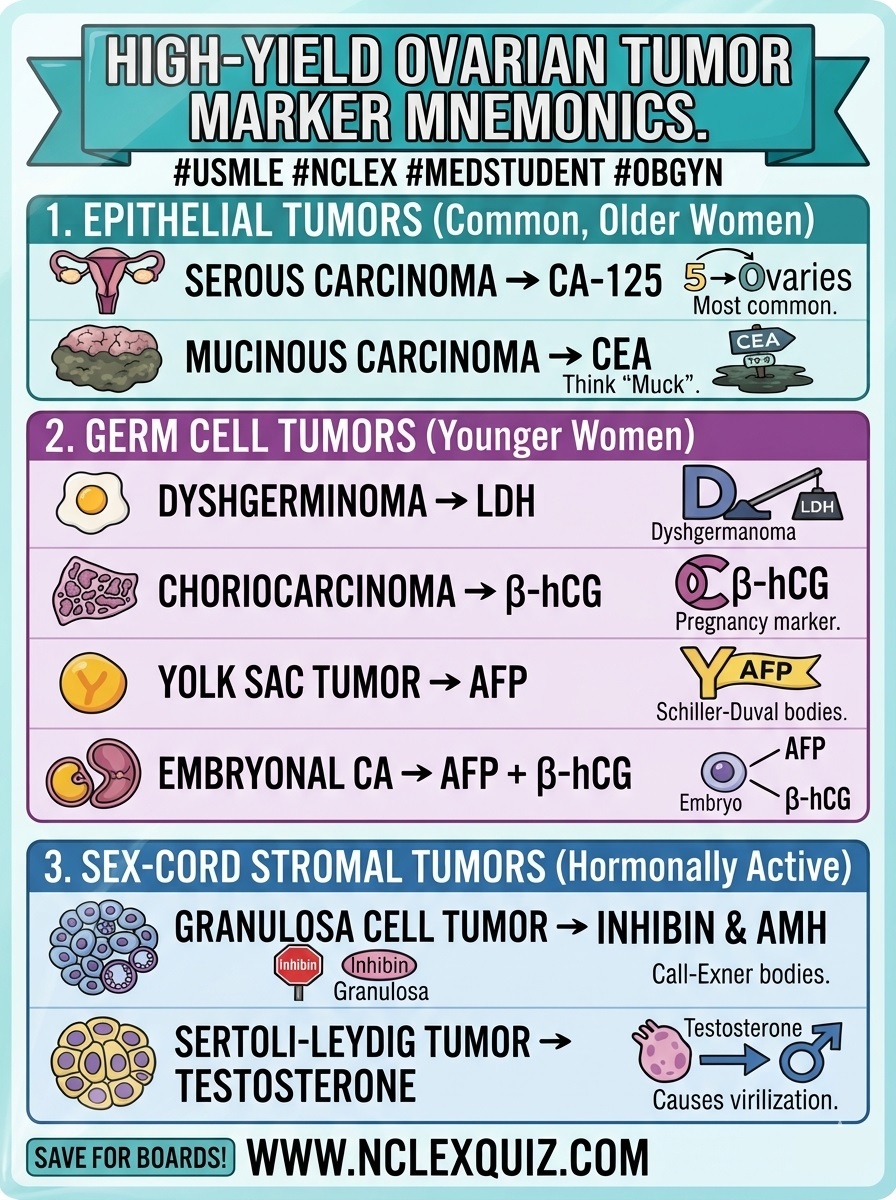
Ovarian tumor markers can be easily memorized by breaking them down by their specific WHO histological classification: Surface Epithelial, Germ Cell, and Sex-Cord Stromal tumors.
Epithelial Ovarian Tumors
These make up the majority of ovarian malignancies.
- Serous Carcinoma → CA-125
Mnemonic: The “5” in 125 looks like an “O” for Ovary. Alternatively, think of 1 uterus and 2 ovaries making up the 125. - Mucinous Carcinoma → CEA & CA 19-9
Mnemonic: Mucinous = Muck. Think of a CEA (sea) full of gastrointestinal muck (since CEA and CA 19-9 are traditionally GI markers).
Germ Cell Tumors
These typically present in younger women and children. Use letter-association to anchor them:
- Dysgerminoma → LDH
Mnemonic: Match the Ds. Dysgerminoma Drives LDH high. - Choriocarcinoma → β-hCG
Mnemonic: Match the Cs. Choriocarcinoma = β-hCG. (Biologically logical, as it derives from placental tissue). - Yolk Sac Tumor → AFP
Mnemonic: AFP = Alpha For Pregnancy/baby. Developing babies rely heavily on a Yolk sac. - Embryonal Carcinoma → AFP + β-hCG
Mnemonic: An Embryo is a combination. It needs both a Yolk Sac (AFP) and a Placenta (β-hCG) to survive.
Sex-Cord Stromal Tumors
These tumors arise from endocrine-active cells and secrete active hormones.
- Granulosa Cell Tumor → Inhibin (A & B)
Mnemonic: Granulosa cells natively secrete Inhibin to inhibit FSH. Think: Granulosa cells Grow, but Inhibin shuts the system down. - Sertoli-Leydig Cell Tumor → Testosterone
Mnemonic: Sertoli and Leydig cells belong in the testes. When they grow in an ovary, they flood the body with male Testosterone.
Leave a Reply